Wearing Empire: 1950s vintage novelty prints

In the 1950s and 1960s novelty prints were popular – in fact I remember a dress my mother made me with cats around the bottom I wore when I was 10.
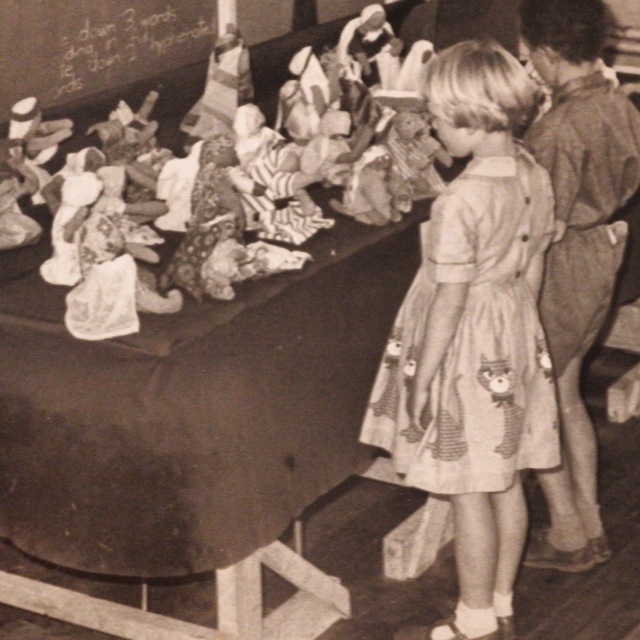
Cat dress - me

These novelty prints were either made into dresses, or designed for, and made into skirts; remember the old photos of girls in skirts and bobby sox?  The subject range of the prints was extensive – animals, people, places, geometric patterns,  – there were dozens of designs to choose from.   A popular group of skits with vintage lovers today are those based on  famous landmarks such as the Taj Mahal, the Grand Canyon, the Oregon Trail, Versailles, the Spanish Steps – the list goes on.  It’s easy to identify the location on these skirts as long as you know your famous landmarks!
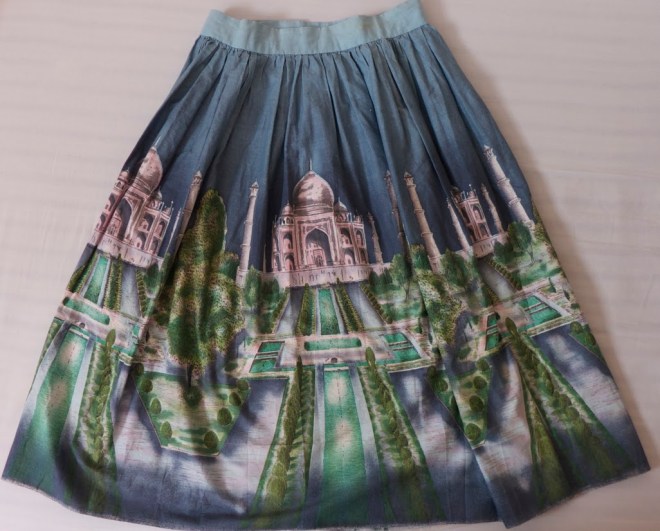
Skirt with Taj Mahal design (private collection)

Skirt with Taj Mahal design (private collection)

Other fabric designs were also of places – but imaginary or artistic interpretations rather than actual places.   My daughter recently bought an interesting novelty print skirt in a vintage shop in London which at first glance seemed to fall into this latter category.
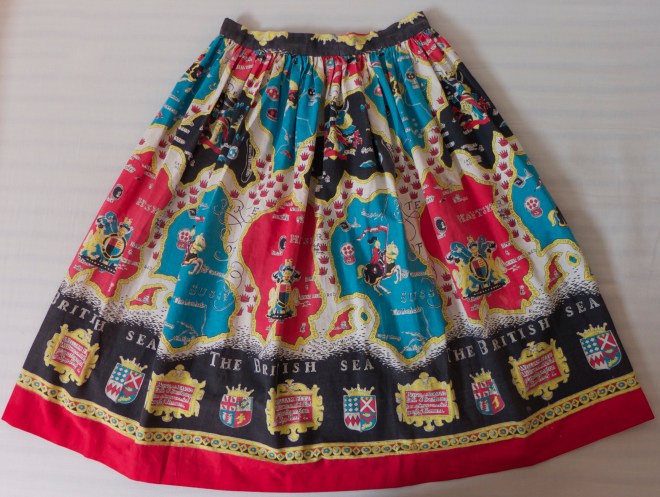
Map skirt - Laura

However, a bit of research revealed  that there’s a lot of historical detail in this skirt.  It shows a stylized map of England with place names which appear to have been in use in the 16th century.  For example Hampshire is “Hantshire” and the English Channel is “the British Sea” There’s also “Downe Hundred”, The Manhode” and many other places marked – fascinating.
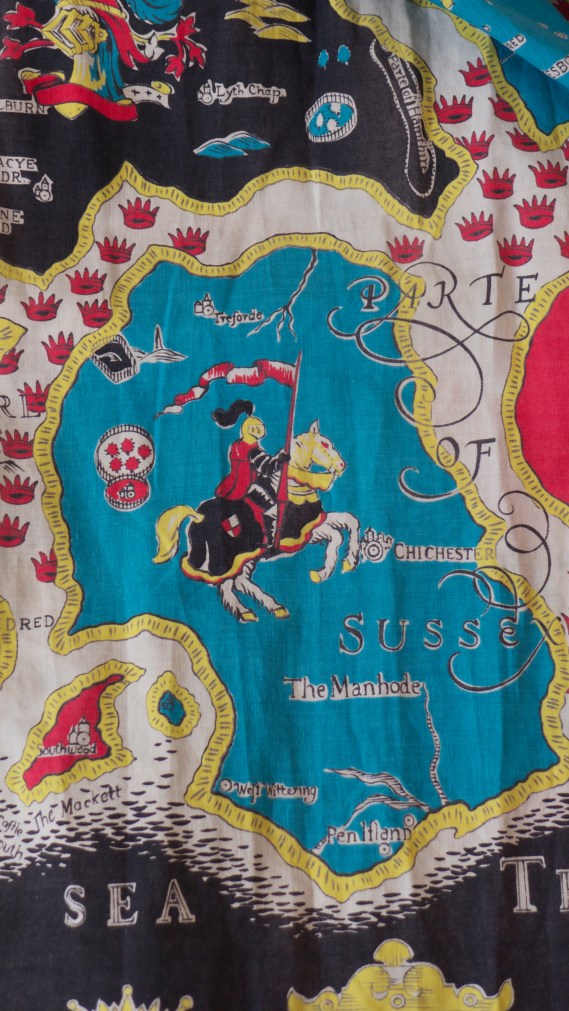
Map skirt 2


At the bottom edge of the skirt are coats of arms and a plaque saying “William Fitz William created Earl of Southampton by King Henry 8”.  William Fitzwilliam was indeed created 1st Earl of Southampton by Henry VIII in 1537.
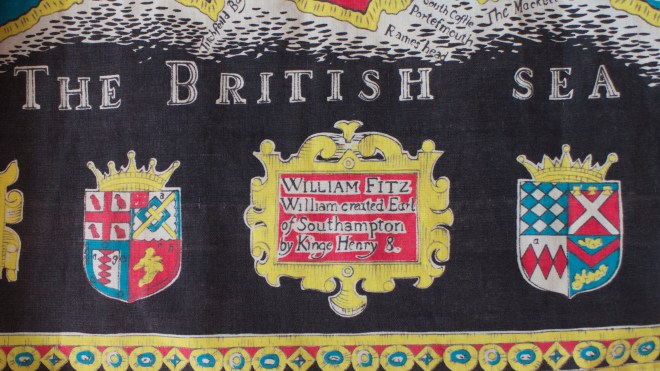
Map skirt - detail of crest


And those the are the First Earl of Southampton’s coat of arms reproduced on the skirt, to the right of the plaque.
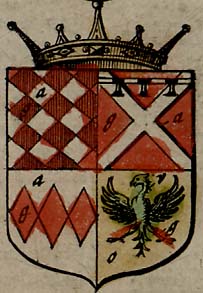
Coat of arms of William Fitzwilliam, 1st Earl of Southampton (from http://www.geog.port.ac.uk/webmap/hantsmap/hantsmap/topics/blazon04.htm)

Coat of arms of William Fitzwilliam, 1st Earl of Southampton (from http://www.geog.port.ac.uk/webmap/hantsmap/hantsmap/topics/blazon04.htm)

Of course what is represented on the skirt is all before Queen Victoria’s time, but it does almost coincide with the beginnings of the British Empire.  It was in 1584, in the reign of Henry VIII’s daughter, Elizabeth 1, that Sir Walter Raleigh set off on his exploration of the Americas.
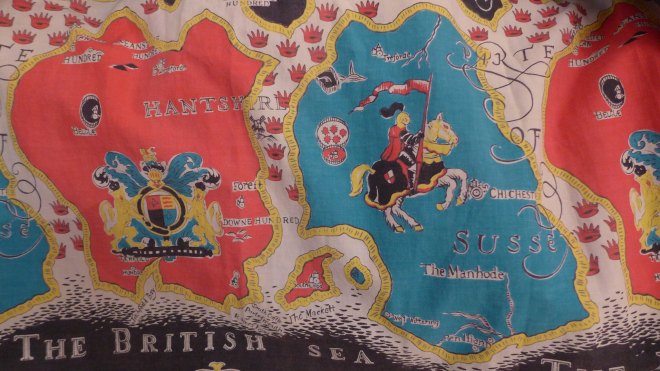
Laura's skirt 1

It’s amazing where you find a slice of history!
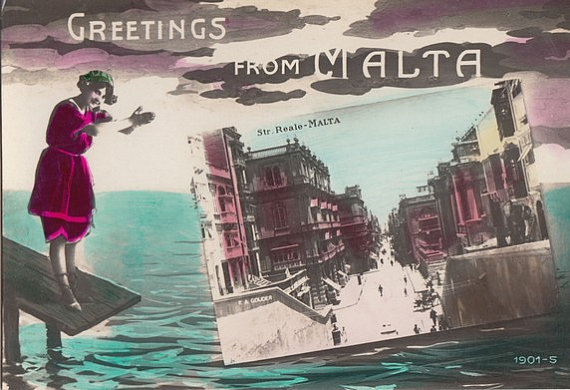
Greetings from Malta: the story behind a postcard

I’ve recently started to collect old postcards – the tinted ones of the 19th and early 20th centuries.  I started my collection when my daughter and I did a vintage road tour of the South Island last year and I needed something to look at in the vintage shops as she tried on vintage clothes.  My collecting obsession soon became as great as hers!

Malta postcardThere are hundreds of tinted postcards for sale but I don’t collect cards of just anywhere instead selecting ones of places I’ve been to, or places I’m interested in going to.   After my visit to Malta I looked at various online sites for postcards and bought a few.  The one I was most interested in arrived today and from the front is a typical holiday card to be sent back to friends and family at home.   It shows Strada Reale (now Republic Street) in Valletta and a girl in an Edwardian (the postcard is dated 1901 on the front) swimming outfit ready to plunge into the Mediterranean.

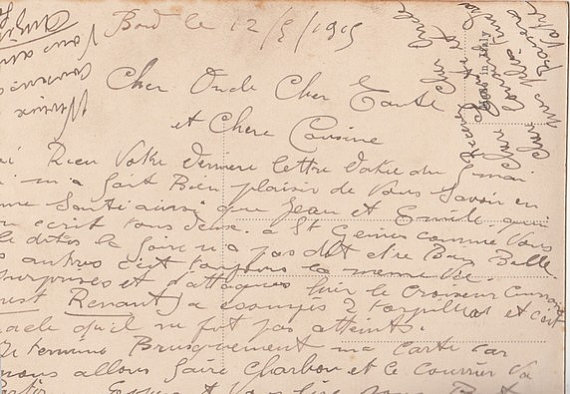
The postcard came from a dealer in Paris called Francis, who sent me a lovely note with it.  Despite this it didn’t occur to me that the card had originally been sent to someone in France and not Britain.  Imagine my surprise when I looked at the back, saw the entire message was written in French and the date was 12 March 1915.

Back of Malta postcard

With my rather rusty schoolgirl French (and some help)  it seems likely the card is from a soldier in Malta, writing to his aunt, uncle and cousins.   He talks of “attacks” and “a miracle”.  He also talks of taking the card to catch “the courier”.  The card has not been sent by post but probably in an envelope which could mean it was one of a few he wrote to be dispatched to France via the courier.   I’ve had a quick look on the internet and  over 100 French soldiers from the First World War are buried in Malta, so it fits.  Dated March 1915 this card pre-dates the beginning of the Gallipoli campaign and the huge influx of wounded to Malta, although it’s not positive from the card that he was wounded; he may have been there for another reason.

It seems such a lovely  coincidence that this plopped into my letterbox today.

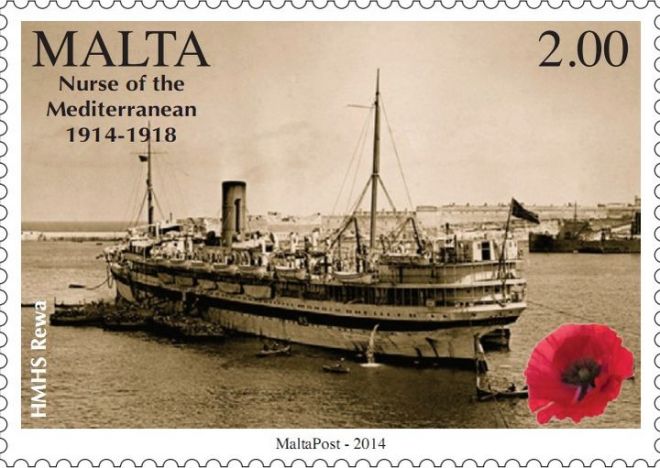
Malta: Nurse of the Mediterranean

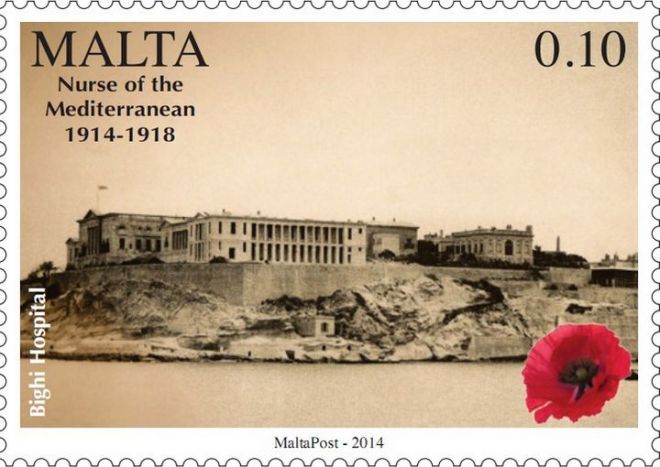
Nurse of the Mediterranean stamp 2

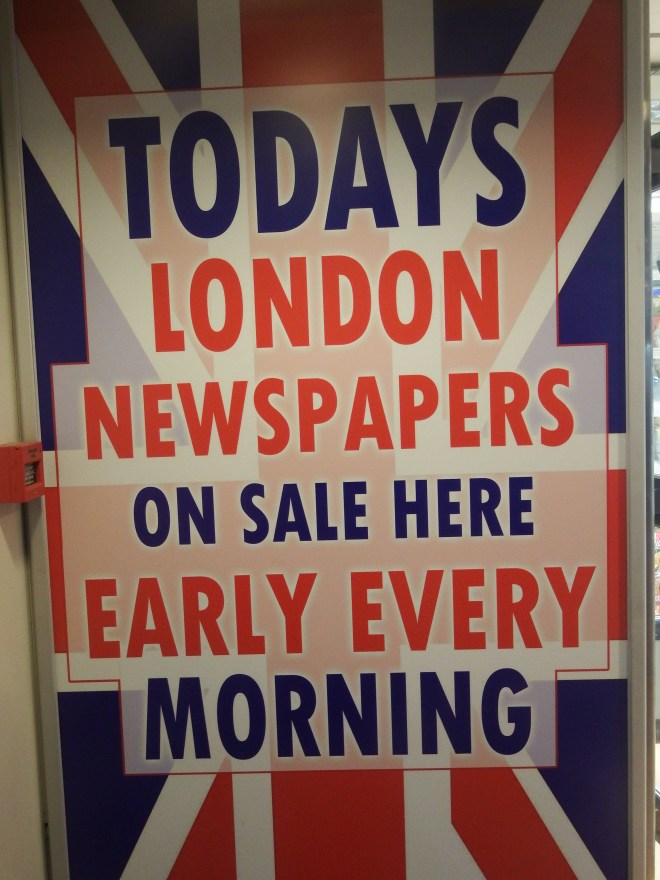
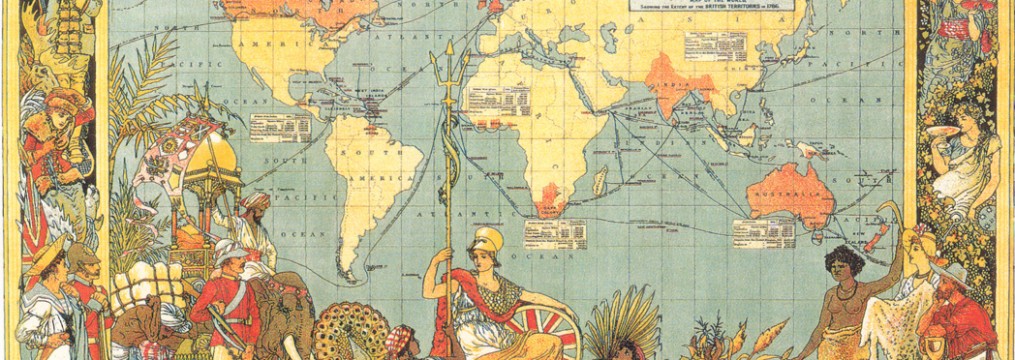
As the 25th of April draws near and plans for commemorating the 100th anniversary of the ANZAC troops landing at Gallipoli gather momentum, I recently discovered an interesting aspect of the campaign I wasn’t aware of  until I visited Malta.  Malta was part of the British Empire from 1800 to 1964 and still retains lots of cultural links with Britain.

London newspapers photo

I always enjoy poking around bookshops when I’m away and usually find books on the place I’m visiting which I haven’t seen elsewhere.  In a bookshop in Valletta I found a small book written about Malta during the British era and reading it was surprised to see Malta described as “the Nurse of the Mediterranean”.  At the airport before leaving I bought some stamps for last minute postcards and again “the Nurse of the Mediterranean” popped up.

Nurse of the Mediterranean stamp

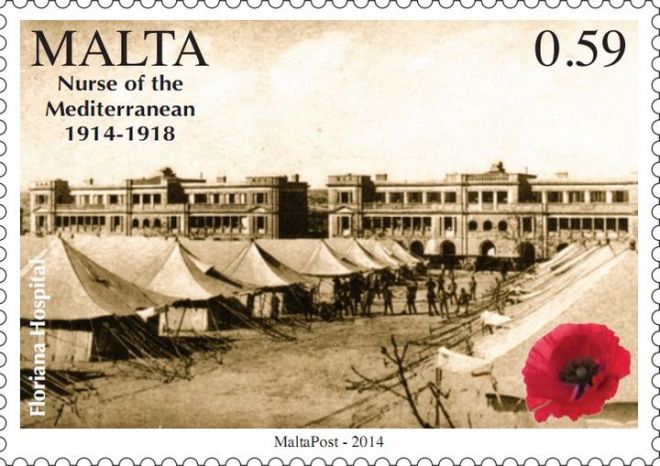
I was intrigued, delved further and was amazed to find that the casualties, known as, casevacs (casualty evacuation cases) from Gallipoli were sent to Malta for treatment.  It’s logical as Malta would have been the closest British possession to Turkey at the time, but I’m surprised more hasn’t been made of Malta’s role in the things I’ve read and heard about New Zealand’s campaign at Gallipoli.

The tiny island really rose to the challenge of caring for the huge number of casualties transported there.  In 1914 there were 278 military beds over four hospitals in Malta but by the end of the war there were 27 hospitals with 25,000 beds.  Over 2,600 officers and 64,500 men from other ranks were evacuated and treated in Malta.

Nurse of the Mediterranen stamp 3

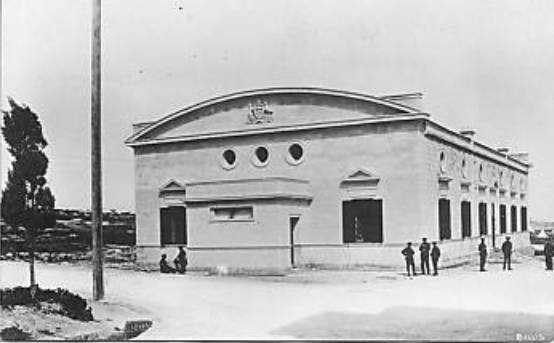
After a voyage from Gallipoli of around a week, each hospital ship was met by groups of Maltese women who worked in shifts to greet and comfort the men with sweets, cigarettes and drinks.  A large sewing party provided pyjamas, shirts, socks and scarves for the patients.   The women did all they could to create a homelike environment for those convalescing, with tea parties, excursions and concerts.  Others also recognised the importance of entertainment to lift morale and the Australia Hall was built as a venue to provide entertainment for the New Zealand and Australian soldiers.

Australia Hall, Malta

Australia Hall, Malta

Little seems to have been written about Malta’s contribution to the ANZAC effort, but it seems unquestionable that many more New Zealanders and Australians would have died but for the efforts of the Maltese people.   I  do hope that in the many books, documentaries and articles on Gallipoli the centenary has spawned there are some that give Malta the credit she deserves.

An episode on Malta was recently screened by the BBC in a series of documentaries about the First World War hosted by Dr Kevin Fong.  See a clip from it here.