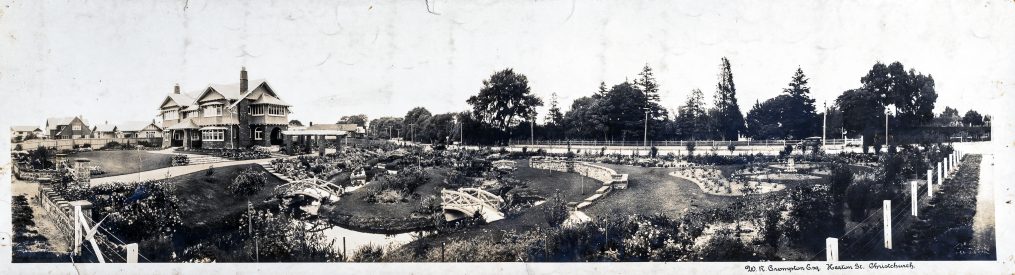
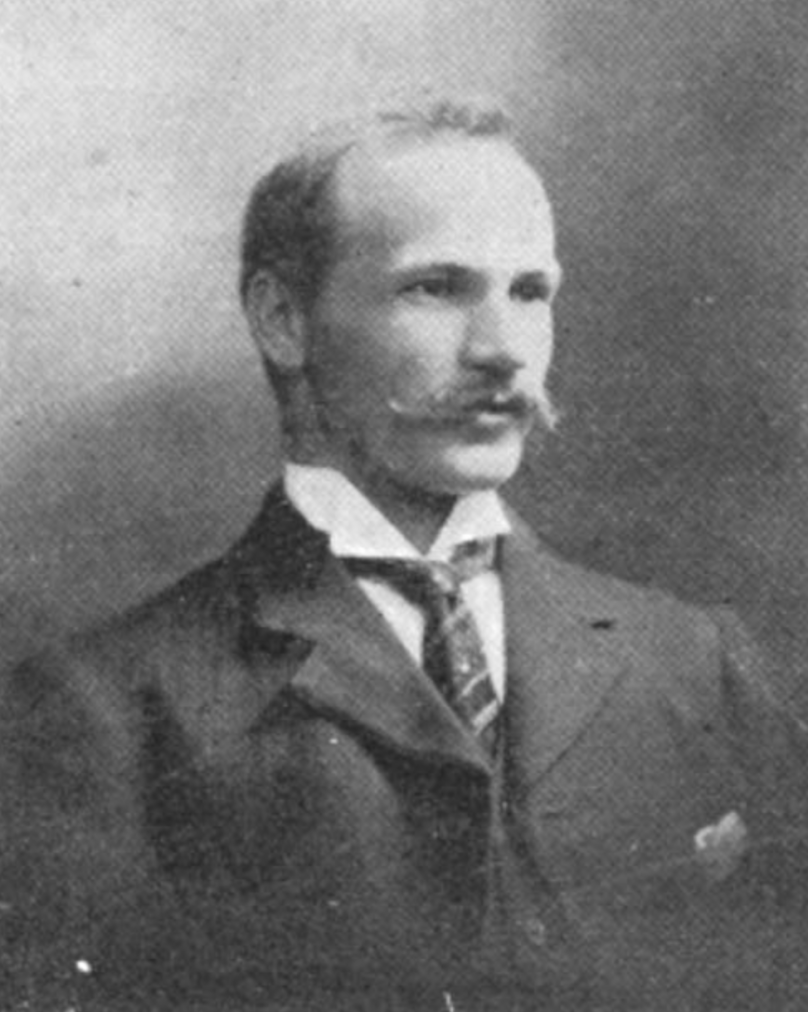
New Zealand’s pre-eminent garden designer, Alfred Buxton, was born in Staffordshire England in 1872 and emigrated to Christchurch, with his family around 1886. Soon after they arrived Alfred was apprenticed to Thomas Abbott, Canterbury’s leading nurseryman. The sound training that Buxton received in the skills needed to be a successful nurseryman would prove invaluable in his future career as a landscape designer.
Alfred completed his apprenticeship in 1891 and in 1896 he opened his first nursery at St Albans. 1896 was a busy year for Alfred in his personal life as well, for in March he married Emily Brown. Alfred and Emily were to have three children; Merle (b 1899), Trevor (b 1901) and Raymond (b 1906).
In April 1898 Buxton began promoting his landscaping business through newspaper advertisements and at the Canterbury Agricultural and Pastoral Society’s show in November that year he took a display stand, the beginning of widespread promotion at A & P shows throughout New Zealand. It was probably this initial display that led to a commission to landscape Duncan Rutherford’s Leslie Hills, around 1900.
Buxton was established enough to issue his first nursery catalogue in 1899. This highlighted his landscape gardening work, ambitiously claiming it was a speciality of the business and stressing his expertise in the laying out of gardens and grounds. The availability of an ongoing garden maintenance service was also promoted. By 1901 the nursery had outgrown St Albans and was moved to what became the Opawa Nursery at St Martins. Alfred and his family lived in a house on the site.
Buxton’s entry in the Cyclopedia of New Zealand of 1903 stated that by this time he employed thirty men in the landscaping department and forty gardens were in the process of being developed.
Extra capital was needed to fund the St Martin’s development so in 1905 Buxton entered into partnership with farmer and businessman, John Pannett, and formed A W Buxton Ltd. The new company took over the Opawa Nursery and listed its business activities as landscape gardening, nursery gardening and asphalting in New Zealand.
The same year Buxton purchased Mr T Turner’s seed and floristry business at 159 Colombo Street, Christchurch. Buxton had advertised as a “gardener and florist” since April 1896 and on purchase of the seed business he set up a floristry department in the same premises. By now Buxton was also offering his customers a recruitment service for gardeners.
Buxton was a member of the Horticultural and Landscape Gardening Committee which oversaw the landscaping of the New Zealand International Exhibition site at Christchurch in 1906, where his business won a gold medal for its horticultural display. The entry included a collection of wares, but what stole the show (and no doubt clinched the medal) was a model landscaped garden, intended to give prospective clients an impression of what their gardens could look like. The eye-catching display was made by Buxton employee, Edgar Taylor. It showed a sweeping drive, gardens laid out with trees, flowers and shrubs and an ornamental lake (of real water) with rustic bridges near the front of the house. Also in the garden were a pergola, glass houses, rock garden, orchard, cherry house, kitchen garden and fowl house. Two million people attended the Exhibition and the interest generated by the model farm led to several commissions from local farmers.
As the business grew, and with the resulting demand for plants, both from landscape clients and the wider public, a larger nursery was required. In November 1912 the nursery expanded to encompass nearly 18 acres (7.3 hectares).
Having successfully established himself as a landscape designer in Canterbury, Buxton sought to expand and looked to another major sheep farming area, the Wairarapa, for commissions. From 1915 he paid regular visits to Masterton in search of clients, staying at a local hotel and advertising his presence there in local newspapers. Most of the commissions in the Wairarapa were up and down the East Coast.
When Buxton and a prospective customer entered into a contract for landscaping the owner had to agree to prepare the site for planting. Because of the remoteness of most of the properties the company landscaped, the owner also had to provide food and accommodation for Buxton’s men, who were often working on a property for many months, sometimes years. Although much of the plant material was available locally, all nursery stock was supplied by Buxton’s Christchurch nursery and consigned to the nearest railway station or siding to the property where it had to be collected by the client.
Landscaping work and expansion continued apace and in 1923 the nursery moved again from St Martins to Belfast. To finance the move and help with cash flow in the business Buxton borrowed 95% of the value of the new nursery site. The business was now in a precarious financial state. The nursery move was costly and an orchard venture had failed. A major client, Roger Murphy of Panikau Station, had died before completing payment for his landscaping and his executors were unwilling to pay the outstanding balance of £3,200 ($375,000 today). Buxton had purchased the freehold of the premises housing the shop and offices in Colombo Street in 1923 and the consequent increase in rates of the company’s vast property interests contributed significantly to the costs of the business.
In June 1926 A W Buxton Ltd went into liquidation and was sold. With the sale of the property, the Buxton family lost their home and went to live with relatives. Alfred and his sons, Trevor and Raymond, who had worked in the company, kept landscaping to fulfil contracts until March 1928, when Alfred Buxton bought a property at 33 Papanui Rd and with his sons formed A W Buxton and Sons Ltd. In 1932 Trevor gave up his shares in the company and was replaced by Alfred’s son-in-law Jim Kirkwood (married to Merle) who became company secretary with a small shareholding. Trevor continued to design gardens which were implemented by A W Buxton & Sons Ltd.
In 1936 Raymond Buxton and Merle and Jim Kirkwood moved to Otaki to grow tomatoes at Homewood on Waerenga Road. When Alfred and his wife, Emily, joined them in 1938, A W Buxton & Sons Ltd ceased trading. At Otaki Buxton grew flowers commercially - irises, gladioli, King Alfred daffodils, violets sweet peas and he was the largest grower of Iceland poppies in the area.
Buxton continued to be involved in local horticultural events and was a vice-president of the Otaki Horticultural and Daffodil Society. He continued to design gardens , including a plan for Tracy Gough of Mona Vale in Christchurch in 1939 and laying out the grounds at William Angus’ Mahanui to a design by his son, Trevor. Alfred Buxton’s final project was for John Sutherland at Seaview Road, Paraparaumu in 1950; he died the same year. His son, Trevor had died in 1948.

